Lead generation for car dealers works best when it is treated as a connected dealership process, not a race to collect the largest possible number of form fills. A campaign can attract attention. The opportunity only becomes useful when the message matches the store, the shopper knows the next step, and someone has a plan for responding.
Call (352) 207-1074 to discuss your dealership’s lead-generation goals
This framework helps dealership leaders evaluate the path from inventory and offers to campaign engagement, lead routing, follow-up, and measurement. It is designed for franchise and established independent dealerships that want more qualified conversations without losing sight of what happens after a shopper responds. BDC Promotions builds that path as a set of services a store can choose separately: campaign creative, paid social, and a defined response handoff.
What lead generation for car dealers actually means
For a dealership, lead generation creates a relevant reason for a shopper to engage. It also makes that engagement something the store can act on. The starting point may be a vehicle, a promotion, a trade-in conversation, or a financing question. The next step might be a form submission, phone call, message, or appointment request.
A lead is an opportunity to follow up. It is not a qualified buyer, a scheduled appointment, a showroom visit, or a sale. A store can raise its marketing numbers and still see little change in sales opportunities. That happens when the campaign attracts the wrong audience, or when the response process breaks down.
A practical lead-generation plan should answer five questions:
- Which inventory, offer, or dealership priority is the campaign supporting?
- Which shoppers are most likely to find that message relevant?
- What action should a shopper take after seeing the message?
- Who owns the response and what happens immediately afterward?
- Which measures will show whether the campaign is creating useful opportunities?
Dealership leaders who want a basic definition of the term can also review this dealership guide to what lead generation is before mapping the process to their own store.
A worked example of lead generation for car dealers
Numbers from a generic marketing dashboard rarely tell a general manager what to change on Monday. A worked scenario does. Consider a franchise store with more than 50 vehicles that wants more conversations about a specific used-truck group, not a larger pile of unrelated form fills. The store writes a one-page brief before anyone builds an ad.
The brief names the truck group and the offer the store can actually honor. It also names the market and the next action. That action is a Messenger reply, or a form that captures vehicle interest and a phone number. Static creative states the offer in one line. A short video shows two trucks from the group so the shopper can see what the offer refers to. Paid social introduces that message to people in the store’s market. The destination repeats the same offer and the same next step, so the shopper is not asked to start over.
Before the campaign runs, the store assigns response ownership. During posted hours, a named person on the BDC or sales desk sees every new response with the truck, the offer, and the source attached. The first reply confirms which truck the shopper asked about and offers a specific day and time to continue the conversation at the store. If that owner is off, a backup is already named. A response that arrives after hours is acknowledged at the start of the next business window, not left until someone notices it.
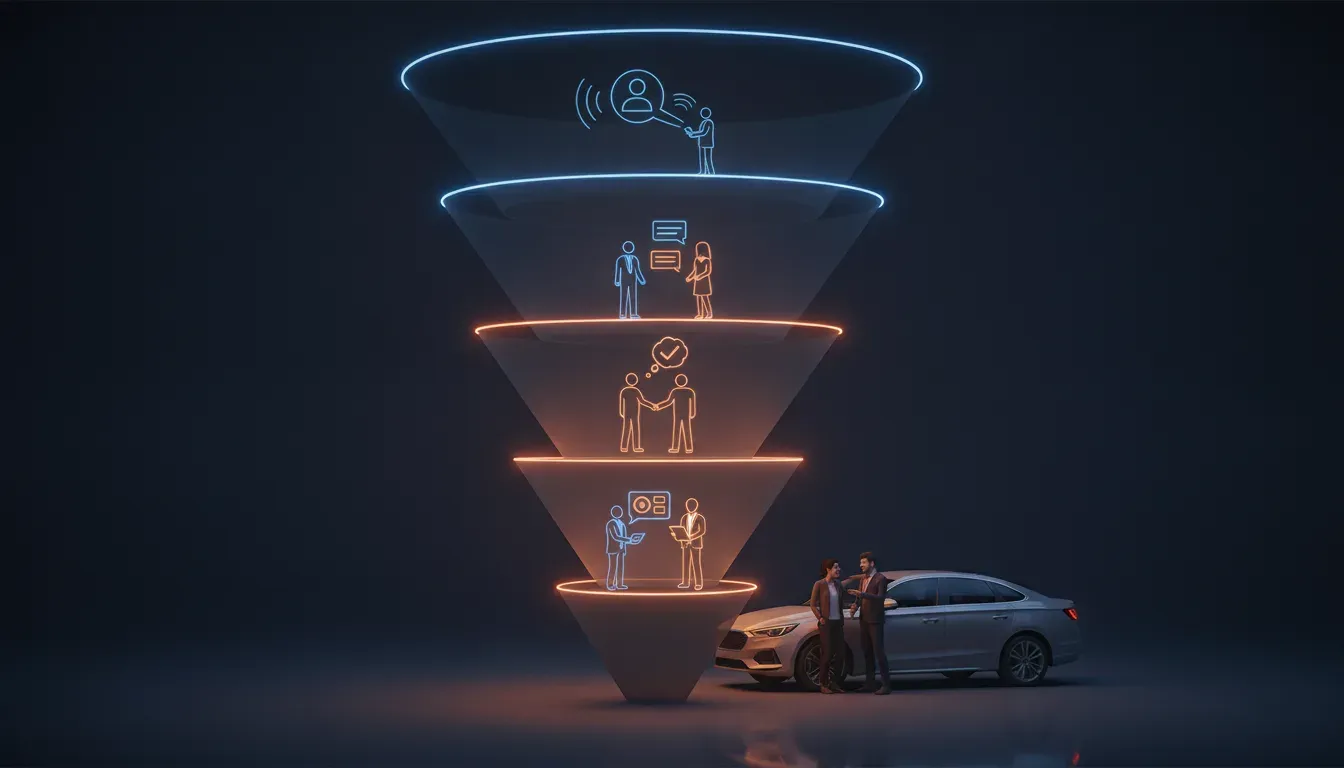
The store then reads the campaign by progression, not by form count. Suppose the first review shows 40 responses, 28 conversations, 12 appointments set, and 7 appointments that showed. Those figures are an illustration of how to read a scorecard, not a result any store should expect. The useful finding is the drop from conversation to appointment. If most shoppers who answered still would not set a day and time, the store changes one thing: the offer language, the audience, or the first question the responder asks. It does not rebuild the whole campaign in the same week.
That is the shape of lead generation for car dealers when it is tied to a store instead of a channel. BDC Promotions’ lead generation services follow the same sequence. They connect inventory and offers to a campaign message, give shoppers a reason to respond, and route that response into an agreed follow-up process.
Start with the dealership goal, not the channel
Choosing a channel before defining the goal often produces disconnected campaigns. A better approach begins with the dealership decision the campaign should support. A store may need to introduce a vehicle group or support a specific offer. It may need more trade-in conversations, or a clearer flow of opportunities into its sales process.
The goal should be specific enough to guide the message and the follow-up plan. “Get more leads” is a starting concern, not a complete campaign brief. A usable brief says something narrower. Create more conversations with shoppers interested in a certain inventory group. Then route those responses to the team that can work them promptly.
Write down the priority, the audience, the offer or reason to respond, the geographic area, and the desired next action. Then confirm the store can support the promise being made. If the campaign highlights inventory, that inventory and its availability need an owner. If it highlights a time-sensitive promotion, the terms and expiration need to be clear before the campaign starts. BDC Promotions describes this planning step as building around the store, starting with the vehicles and offers the dealership wants shoppers to notice.
Build the message around a real shopper reason
People rarely respond because a dealership says it wants more leads. They respond because the message connects to something they are trying to solve or explore. A useful campaign gives the shopper enough context to decide whether the next step is worth taking.
That reason could be a clearly presented vehicle group, an offer with understandable terms, a way to value a trade, or an invitation to discuss options with the dealership. The message should make the intended audience and next action easy to understand. Avoid making a promise that the store cannot verify or support after the response arrives.
Creative also needs to fit the inventory and the audience. Static creative can make a focused offer easy to scan. Video can demonstrate a vehicle, promotion, or dealership point of view when the format is suited to the message. BDC Promotions’ automotive ad creative covers static ad creation and video creation or editing so the campaign has a message built for the vehicles, not a generic template. The choice of format is less important than consistency between the creative, landing experience, lead form, and follow-up conversation.
Before launch, ask a salesperson or manager to read the message as a shopper would. Can they tell what is being offered, who it is for, and what happens if they respond? If not, more traffic will not fix the underlying problem.
Choose channel roles instead of expecting one channel to do everything
Different channels can support different parts of the lead-generation plan. Paid social may help a dealership introduce inventory or an offer to a defined audience. Facebook and Messenger campaigns are a core part of how BDC Promotions designs that introduction, because the message and the reply can sit in the same conversation. Search can capture demand from people already looking for a dealership, vehicle, service, or solution. Email and other follow-up channels can help continue a conversation with people the store already has permission to contact.
The channel should match the job. A campaign built to create awareness may need a different message and success measure than a campaign aimed at immediate appointment requests. A dealership can also use more than one channel, but each channel needs a clear role and shared definitions for what counts as a response or qualified opportunity.
| Channel or asset | Useful role | Question to answer before launch |
|---|---|---|
| Paid social | Introduce relevant inventory, offers, or dealership messages to a defined audience | What makes this audience likely to respond now? |
| Search and local demand | Capture shoppers already researching a vehicle, dealership, or next step | Does the destination answer the query and make contact easy? |
| Static or video creative | Make the campaign message easier to understand and remember | Does the format show a clear reason to engage? |
| Lead form or Messenger path | Turn interest into a response the dealership can act on | Who receives it, how quickly, and with what context? |
| Follow-up process | Continue the conversation and work toward a useful next step | What happens when the shopper replies, is unavailable, or is not ready? |
For a deeper comparison of measurement across sources, see the car dealer lead source comparison. The key lesson is to compare sources by the opportunities they create, not only by the number of initial responses. Stores promoting a specific vehicle group can also review inventory advertising as the place where those vehicles and offers are connected to the campaign.
Design the handoff before the campaign runs
The handoff is where many lead-generation plans become vague. Before launch, identify which team receives a form, call, or message, what information is passed along, and what the first response should accomplish. A lead-routing plan can be simple, but it should be explicit.
At minimum, define:
- The destination for each type of response.
- The person or team responsible during business hours and outside them.
- The information that must be visible, such as vehicle interest, offer, source, and contact details.
- The first response objective, such as confirming interest, answering a question, or proposing an appointment conversation.
- The backup plan when the usual owner is unavailable.
Speed matters, but speed without context can create a poor experience. A response should acknowledge what the shopper asked about and make a sensible next step clear. The store should also have a way to record the outcome so marketing and sales are not judging the campaign from separate, incomplete data.
BDC Promotions separates campaign support from follow-up ownership. Facebook Messenger response and BDC staff can continue a shopper conversation toward a scheduled day and time. The dealership should still agree who owns the response before the campaign runs. Its lead nurturing and appointment-setting service defines that next stage. That includes prequalification questions, coverage, and how appointment details reach the store. A scheduled appointment is an opportunity for the sales team. Attendance and a sale are not guaranteed.
Measure progression, not just lead volume
A useful scorecard follows the shopper from first response toward a dealership outcome. The exact definitions will vary by store, but the measurement path should make it possible to see where opportunity is created and where it is lost. Use the same definitions the worked truck example uses: response, conversation, appointment set, and appointment shown.
Consider tracking:
- Reach or impressions, to understand whether the campaign is being delivered.
- Engagement, to see whether the creative gives the audience a reason to pay attention.
- Responses, including forms, calls, and messages, with the source recorded.
- Contact rate, so the store can distinguish a delivered response from a conversation.
- Qualification rate, using a definition the sales and marketing teams share.
- Appointments set and appointments shown, when the campaign’s goal supports that path.
- Opportunity or sold measures only when attribution and timing make them reliable.
Do not assume a low cost per lead automatically means a strong campaign. A cheaper response can be less valuable if it lacks context, cannot be reached, or does not align with the dealership’s inventory and offer. Conversely, a campaign with a higher initial cost may create better conversations if the downstream rate is stronger. No cost figure here is a quote or a promised result.
The dealership lead response monitoring guide can help teams think about the operational measures that sit between an incoming response and a meaningful opportunity. Review the numbers on a schedule, then use the findings to adjust the audience, creative, offer, routing, or follow-up process.
Protect shopper trust and dealership data
Lead generation depends on a shopper trusting the dealership enough to respond. The form or call-to-action should say what the shopper is asking for and avoid hiding important conditions. The dealership also needs a clear understanding of how contact information will be used, who may access it, and how opt-outs are handled.
Operational safeguards are part of the marketing process. Limit access to lead details, keep systems and vendors documented, and avoid collecting information the campaign does not need. Dealerships that share consumer information with affiliates or other companies also have privacy-notice duties under the Gramm-Leach-Bliley Act. The Consumer Financial Protection Bureau’s privacy notice guidance explains the annual notice and opt-out rules for that sharing. It is not a substitute for legal advice. It is a concrete place to start when a store reviews what happens to a shopper’s contact details after a form is submitted.
Also make sure campaign language, financing references, vehicle availability, and promotional terms are reviewed by the appropriate dealership owner before launch. Clear expectations protect the shopper and make the follow-up conversation easier for the team.
Use a simple 30-day improvement cycle
A dealership does not need to redesign its entire marketing operation before learning from a campaign. A bounded review cycle can reveal the highest-value improvement. Apply it to one inventory group, the way the truck example does, so the review stays small enough to finish.
- Week one: confirm the path. Check the message, destination, form or Messenger path, routing, ownership, and tracking before spending begins.
- Week two: inspect response quality. Review a sample of responses for relevance, missing information, duplicate records, and whether the first follow-up made sense.
- Week three: compare progression. Look at contact, qualification, appointment, and show rates by source or campaign where the data supports it.
- Week four: choose one change. Adjust one meaningful variable, such as the offer, audience, creative, routing, or follow-up expectation, and document why.
This cycle reduces the temptation to change everything at once. It also gives the dealership a clearer explanation for what improved, what did not, and what needs more evidence.
How BDC Promotions can fit the framework
BDC Promotions, Inc. provides automotive marketing and customer engagement for franchise and established independent dealerships. The lead-generation work starts with the store’s priorities. Those include the inventory and offers that need support, the market being considered, the current response process, and the measures leadership uses to judge opportunity quality. Services can be chosen separately. A store can start with creative and a paid social campaign, then add appointment support when the response volume justifies it.
You can review the lead-to-showroom process to see how campaign activity connects with the next steps, or explore the automotive lead-generation dealership guide for related planning context. The fit conversation should clarify campaign scope, creative needs, response ownership, and reporting expectations before a store commits to a path.
Request a dealership marketing consultation to walk through your inventory, offers, and how shopper responses are handled today. You can also call (352) 207-1074.
Frequently asked questions
What is the best lead source for a car dealership?
There is no universal best source. The right source depends on the dealership’s inventory, offer, audience, market, response capacity, and downstream results. Compare sources using contact, qualification, appointment, show, and sales measures where attribution is reliable, not only response volume.
How many leads does a dealership need?
The useful number depends on the store’s goals and capacity. A dealership should first define how many qualified conversations or appointments it can work well, then build a campaign and follow-up process around that capacity. More unworked responses are not automatically better.
Should a dealership focus on forms or phone calls?
Use the path that matches the shopper’s situation and the store’s ability to respond. Forms and Messenger threads can capture vehicle and offer context. Calls may be useful when a shopper wants an immediate conversation. Both need tracking, ownership, and a clear next step.
What should happen after someone submits a lead form?
The assigned owner should see the shopper’s context and acknowledge the request. They should answer the immediate question when they can, then guide the conversation toward a next step such as a scheduled day and time. The outcome should be recorded so the dealership can learn whether the response path is working. A response is not a showroom visit and not a sale.
Build the next step around your dealership
Lead generation for car dealers is not one ad, one form, or one dashboard number. It is a connected framework. Start with a dealership priority and a credible reason to respond. Choose channels for specific roles, plan the handoff, and measure progression toward useful opportunities.
To discuss your inventory, offers, campaign priorities, and response process, request a dealership marketing consultation or call (352) 207-1074.