

An automotive dealership BDC is more than a group of people who answer leads. A well-designed BDC gives every shopper a clear next step. It gives sales and service teams better-prepared opportunities. It also shows dealership leaders where demand is being lost. BDC operations connect marketing, customer conversations, appointment setting, showroom handoffs, and follow-up into one working system.
Talk with BDC Promotions about your dealership's appointment generation goals.
This guide explains how that system works, what each role should own, which workflows deserve attention first, and how to build a practical scorecard. This guide is for dealership owners, general managers, BDC directors, marketing managers, sales leaders, and service leaders. It helps them build consistent opportunities without creating confusion for the rest of the store.
What are automotive dealership BDC operations?
Automotive dealership BDC operations are the people, processes, tools, and handoffs used to manage shopper communication before a showroom visit or service appointment. The operating goal is not simply to create activity. It is to respond clearly, qualify the next step, schedule useful appointments, confirm them, and make the handoff easy for the team that receives the customer.
A BDC, or business development center, usually works in the space between an incoming opportunity and a department-level outcome. An opportunity can begin with a paid social response, website form, phone call, text conversation, service request, equity question, or past customer follow-up. The BDC helps the dealership decide what should happen next and who should own it.
The exact structure varies by dealership. Some stores operate one BDC for sales and service. Others separate internet sales, service scheduling, and retention work. Some keep the team fully in-house, while others use an outside partner for selected communication or campaign functions. The label matters less than the operating contract. Everyone should know who responds, what information is confirmed, how an appointment is defined, and when a lead moves to another owner.
Why does a dealership need an operating model for its BDC?
A dealership needs an operating model because lead generation and appointment generation are different jobs. Marketing can create attention and inquiries, but the BDC must turn those inquiries into organized conversations and the next appropriate action. Without a shared model, leads may be duplicated, responses may vary by employee, appointment details may be incomplete, and managers may see volume without understanding quality.
A useful operating model answers five questions:
- Which sources create opportunities for the BDC?
- Which team owns the first response?
- What information must be confirmed before an appointment is scheduled?
- How does the BDC hand off the customer to sales, service, or another department?
- Which measures show whether the system is improving?
These answers create consistency without forcing every conversation into a rigid script. A BDC representative still needs judgment. The model simply makes the boundaries visible so that judgment happens inside a dependable process.
How does a dealership BDC fit into the sales and service organization?
A dealership BDC works best as a connective function, not as an isolated department. It supports marketing by responding to demand, supports sales by creating better handoffs, supports service by organizing scheduling conversations, and supports leadership by making customer communication measurable. The BDC should have a clear owner, but it must operate with shared definitions across the store.
Ownership normally sits with a BDC director, internet director, sales manager, service manager, or general manager. The right reporting line depends on the dealership's goals and department structure. What matters is that the leader can resolve conflicts about coverage, appointment definitions, data access, and handoff quality.
Sales and service may share a platform, but their conversations are not identical. A sales BDC may discuss vehicle interest, trade-in intent, availability questions, and a visit to the showroom. A service BDC may discuss maintenance needs, preferred times, repair concerns, and advisor availability. Both need accurate information, clear escalation rules, and a reliable way to confirm the next step.
Use a responsibility map to make the relationship explicit:.
| Operating area | Primary BDC responsibility | Department responsibility |
|---|---|---|
| New inquiry. | Acknowledge, understand the request, and establish the next step. | Provide current inventory, offer, or department information when needed. |
| Qualification. | Capture useful context without creating unnecessary friction. | Define which details are required for a productive handoff. |
| Appointment. | Offer times, confirm details, and record the appointment clearly. | Prepare for the customer and identify the receiving owner. |
| Escalation. | Recognize questions that require a manager, product expert, or advisor. | Respond to escalated questions and return the outcome to the BDC. |
| Follow-up. | Maintain the agreed communication cadence and document outcomes | Share status changes so follow-up remains accurate. |
.
BDC Promotions describes its dealership work around fast lead response, professional Facebook Messenger communication, paid social campaigns, and appointment generation. That combination shows why the handoff matters: an ad or message only becomes useful when the dealership knows what to do with the resulting conversation. Review BDC Promotions services for dealerships when comparing the marketing and appointment parts of the system.
What roles are involved in BDC operations?
Effective BDC operations assign work by decision and handoff, not only by job title. A representative may handle first response and appointment setting, while a BDC director manages quality and capacity. Sales managers, service advisors, marketing leaders, and general managers each have a role in keeping the system accurate after a lead enters the dealership.
BDC director or manager
The BDC leader owns the operating rhythm. That includes coverage planning, coaching, quality review, escalation rules, reporting, and coordination with sales, service, and marketing. This role should also own the definitions behind the scorecard. If one manager calls a conversation an appointment and another calls it a lead, the reports will not support good decisions.
BDC representatives
Representatives respond to shoppers, ask useful questions, document the conversation, propose the next step, and keep follow-up moving. The strongest representatives do not treat every interaction as a race to deliver a scripted pitch. They listen for intent, protect accuracy, and make the next action easy for the customer.
Sales and service receiving owners
The receiving employee is part of the BDC experience. A clean handoff tells that person who the customer is, what the customer asked for, what was promised, when the customer is expected, and what remains unresolved. If the receiving team cannot see or trust that information, the BDC will be judged on a result it cannot control alone.
Marketing and advertising owners
Marketing leaders should connect campaign messages to the conversations they create. If creative promises a specific vehicle, offer, or event, the BDC needs current details and an escalation path. Marketing and BDC leaders should review not only lead volume but also the quality and recurring questions produced by each campaign.
What happens from a new lead to a dealership appointment?
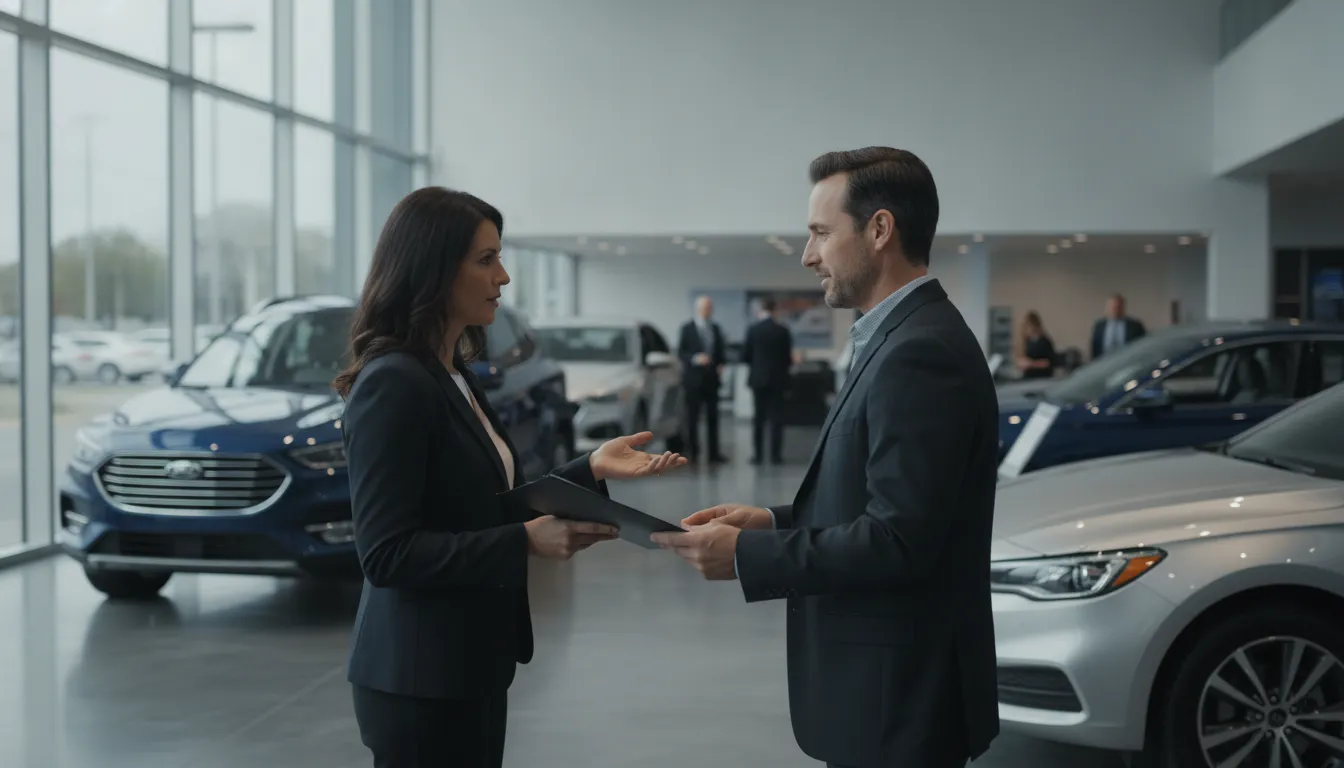
The path from a new lead to an appointment should be simple enough to teach and flexible enough to fit the shopper. A dependable BDC workflow identifies the source, responds with context, learns what the shopper needs. Offers a realistic next step, records the details, confirms the appointment, and completes the handoff. Each stage should have one owner and one definition of completion.
- Capture and route: Identify the source, customer details, department, campaign context, and any existing record. Route the opportunity to the correct queue without creating duplicates.
- Respond with context: Acknowledge the shopper's request and answer what can be answered accurately. The first response should feel connected to the inquiry, not copied from an unrelated template.
- Understand intent: Determine whether the shopper is asking about a vehicle, a trade, financing, service, an event, availability, or general information. Ask only the questions that improve the next step.
- Recommend an action: Offer a visit, call, service time, video conversation, or another appropriate next step. A useful action is specific enough for the customer and realistic for the department.
- Record and confirm: Enter the appointment details, preferences, vehicle or service context, and unresolved questions in the system. Confirm the time, location, and expected contact.
- Handoff and prepare: Notify the receiving owner, provide the conversation context, and make sure the customer does not have to repeat the entire request on arrival.
- Follow through: Confirm the appointment according to dealership policy, document the outcome, and route missed or stalled opportunities into a defined follow-up path.
The process should also describe what happens when the customer is not ready to schedule. A shopper may need a vehicle answer, a trade discussion, a service estimate, or time to compare options. A BDC can preserve the relationship by setting a clear follow-up expectation instead of forcing an appointment that does not fit the customer's intent.
How should a dealership manage sales and service BDC workflows?
Sales and service workflows should share a common operating foundation while keeping their department-specific details separate. Both need source tracking, ownership, response standards, appointment definitions, escalation rules, and outcome reporting. The difference is the customer job: sales conversations move toward a vehicle opportunity, while service conversations move toward a repair, maintenance, or advisor appointment.
For sales, a useful workflow may distinguish new-vehicle interest, used-vehicle interest, trade intent, financing questions, inventory requests, and general dealership questions. For service, the workflow may distinguish maintenance scheduling, repair concerns, recall questions, parts requests, and follow-up for declined work. These categories help route the conversation without forcing a representative to diagnose an issue beyond their authority.
Departments should agree on:
- Who owns after-hours responses and what the first reply can promise.
- Which questions require a sales manager, service advisor, finance manager, or product specialist.
- How appointment availability is checked and updated.
- Which appointment details must be visible to the receiving team.
- How cancellations, no-shows, reschedules, and unreachable customers are recorded.
- How a customer moves from sales to service or from service to a vehicle conversation.
Do not use a single blended metric to hide department differences. Sales appointment activity and service appointment activity can be reviewed together at the leadership level, but the definitions and operational levers should remain clear.
Which technology does an automotive dealership BDC need?
A dealership BDC needs technology that makes ownership, context, timing, and outcomes visible. The best stack is not the one with the most features. It is the one that helps the team receive every opportunity, respond consistently, record the right details, and give managers trustworthy evidence about what happened next.
Core technology areas usually include:
- Lead and customer records: A CRM or equivalent system that preserves contact history, source, department, owner, status, and appointment information.
- Communication channels: Phone, email, text, website forms, and social messaging where the dealership actually receives shopper responses.
- Routing and alerts: Rules that direct new opportunities to the right queue and make unworked or aging records visible.
- Appointment visibility: A calendar, CRM view, or department system that helps the BDC offer realistic times and helps the receiving team prepare.
- Reporting: A scorecard that connects source, response, conversation, appointment, and downstream outcome without overstating attribution.
- Quality controls: Conversation review, permission controls, change logs, and a process for correcting inaccurate vehicle, offer, or service information.
Technology cannot repair an undefined process. Before adding automation, map the human decisions that must happen. Then decide which reminders, routing rules, templates, or integrations remove repetitive work without removing the judgment required for a useful customer interaction.
A system audit should ask whether every opportunity has one current owner. Staff should see the source and prior context. Managers should identify aging records. Appointments should be recorded consistently. The dealership should be able to export or review its own history. If the answer is no, the first improvement may be governance rather than another tool.
Which BDC metrics should dealership leaders track?
A BDC scorecard should move from activity to progress. Start with the number of opportunities received. Show how consistently they were worked. Track conversations that reached a defined next step, appointments that were set and confirmed, and what happened after the handoff. The scorecard should help a manager choose an action, not simply rank representatives..
| Metric group | Question it answers | Management action |
|---|---|---|
| Coverage | Did every opportunity receive an owner and a response attempt? | Review routing, staffing, hours, and queue alerts |
| Response quality | Did the response address the request and create a useful next step? | Coach context, accuracy, tone, and escalation |
| Conversation progress | Did the interaction move from inquiry to a defined customer action? | Review questions, offers, friction, and source quality |
| Appointment setting | How often did a qualified conversation become a scheduled visit or service time? | Review availability, qualification, and appointment language |
| Appointment confirmation | Were the details confirmed and understood by the customer? | Improve reminders, details, and receiving-team preparation |
| Show and outcome | What happened after the appointment was set? | Review handoff quality, customer experience, and department follow-through |
| Follow-up health | Are stalled, canceled, and missed opportunities receiving the intended next action? | Improve task rules, ownership, and review cadence |
.
Define every metric in writing. For example, an appointment should have a customer, a department or purpose, a scheduled time, and enough context for the receiving employee to act. A set-rate percentage without a shared definition can create false confidence. Likewise, a show-rate measure should be read alongside appointment quality, confirmation practice, store capacity, and the customer's reason for visiting.
Review metrics by source and department when possible. A campaign that produces many inquiries but few useful conversations may need a message or targeting change. A source with good conversations but weak appointments may need better availability or a clearer handoff. A team with strong appointment setting but weak outcomes may have a receiving-process problem rather than a BDC problem.
See how BDC Promotions frames the path from dealership marketing to appointment opportunities.
What are the most common BDC operations problems?
Most BDC problems are operating gaps, not individual failures. Leads can be missed when routing is unclear. Conversations can stall when the next step is vague. Appointments can disappoint when details are incomplete. Reports can mislead when departments use different definitions. Diagnose the handoff before assuming that more leads or more staff will solve the issue.
Slow or inconsistent first response
Review queue ownership, coverage hours, alerts, and the information available at the moment of response. If the team cannot see the source or customer request, even a fast response may feel irrelevant. Create an escalation path for records that cannot be answered accurately.
Lead volume without appointment progress
Separate source quality from conversation quality. Read samples of conversations, compare the customer's original request with the response, and check whether the BDC is offering a specific next step. Also review whether the dealership actually has appointment availability that matches the campaign promise.
Appointments that do not convert to useful handoffs
Check whether the customer receives the expected time, location, and purpose, and whether the receiving employee sees the same information. Handoff failure often appears as a show-rate issue even though the root cause started before the visit.
Reports that cannot guide decisions
Remove vanity measures that do not connect to an action. A dashboard should help a manager decide whether to adjust routing, coaching, source mix, coverage, appointment availability, or follow-up. If a metric does not change a decision, it may not belong on the primary scorecard.
Conflicting messages
Keep current offers, inventory language, service details, and escalation contacts in one controlled source. Give representatives a safe way to say that a specialist will confirm a detail. Accuracy is more valuable than an overconfident answer that creates a poor customer experience.
How should a dealership decide between in-house and outsourced BDC support?
The in-house versus outsourced BDC decision should be based on control, coverage, process maturity, staffing needs, and the type of work being delegated. A dealership does not have to choose one model for every function. It can keep core customer and department decisions in-house while using an outside specialist for selected campaigns, messaging, overflow, or appointment-focused support.
An in-house model may offer close day-to-day alignment with inventory, managers, service capacity, and store culture. It also requires the dealership to own recruiting, training, coverage, quality review, technology administration, and continuity when staffing changes. An outsourced model may provide a specialized operating team and additional coverage. But the dealership must define access, approvals, escalation, data ownership, and the receiving-team handoff before work begins.
| Decision factor | Questions to answer |
|---|---|
| Control | Which decisions must remain with dealership employees, and which tasks can a partner perform? |
| Coverage | When do shoppers need a response, and who covers gaps, weekends, or campaign spikes? |
| Consistency | Can the chosen model maintain approved messaging, accurate details, and documented escalation? |
| Integration | Can the team work in the required CRM, communication channels, calendars, and reporting views? |
| Accountability | Who reviews conversations, fixes errors, and owns the result after the handoff? |
| Exit and continuity | What happens to records, access, workflows, and active conversations if the arrangement changes? |
Do not compare providers only by promised lead volume or an attractive service list. Ask for the exact workflow, a sample handoff, reporting definitions, approval process, and escalation examples. Use this dealership marketing agency evaluation guide as a companion when reviewing a partner's specialization, lead handling, reporting, approvals, and appointment focus.

How can a dealership improve BDC operations in 30, 60, and 90 days?
A practical BDC improvement plan starts with visibility, then fixes ownership and handoffs, then builds a repeatable learning rhythm. A dealership does not need to change every tool or rewrite every message at once. It needs a short sequence that exposes the largest source of lost opportunity and assigns one accountable owner to each fix.
First 30 days: establish the baseline
- List every lead and conversation source, including paid social, website, phone, text, and service channels.
- Document routing rules, coverage hours, ownership, escalation contacts, and appointment definitions.
- Review a representative sample of conversations for response context, accuracy, next-step clarity, and handoff quality.
- Build a simple scorecard with coverage, response, conversation, appointment, confirmation, and outcome fields.
- Remove duplicate queues and correct missing or outdated dealership information.
Days 31 to 60: repair the workflow
- Rewrite the first-response framework around customer intent rather than one universal script.
- Make the appointment record and receiving-team handoff consistent across departments.
- Set review rules for aging, stalled, canceled, missed, and unassigned opportunities.
- Coach representatives using real conversations and specific examples instead of general criticism.
- Connect marketing and BDC leaders so campaign changes include an updated follow-up plan.
Days 61 to 90: build the learning loop
- Review the scorecard by source, department, representative, and appointment outcome.
- Test one workflow improvement at a time and document what changed.
- Use recurring customer questions to improve campaign creative, landing-page information, and internal guidance.
- Confirm access, permissions, data retention, and continuity procedures.
- Set a leadership review cadence that ends with owners and next actions, not only charts.
This sequence creates a stronger base for later decisions about staffing, automation, channel expansion, and vendor support. It also gives the dealership a defensible way to explain what changed and why performance moved.
What quality controls protect the customer experience?
Quality controls make BDC operations safer and more consistent without turning conversations into robotic exchanges. The control system should protect accuracy, privacy, approvals, handoff clarity, and follow-up ownership. It should also make it easy to correct a mistake quickly and learn from it without blaming one representative for a process problem.
Useful controls include:
- A current reference for inventory, offers, service information, hours, locations, and approved claims.
- Permission rules for CRM records, communication tools, advertising accounts, and reporting.
- A review process for inaccurate, outdated, or disputed information.
- Conversation sampling that checks helpfulness, accuracy, tone, escalation, and next-step clarity.
- Clear boundaries for questions about financing, pricing, trade values, availability, warranties, and vehicle condition.
- A documented process for opt-outs, do-not-contact requests, and communication preferences.
- One owner for each exception queue, including stalled, duplicate, canceled, and missed appointments.
Quality review should look for patterns. If multiple representatives make the same mistake, update the operating guidance or source data. If one channel creates repeated confusion, improve the campaign or routing design. If the receiving department routinely lacks context, fix the handoff field or notification rather than simply asking the BDC to try harder.
Frequently Asked Questions About BDC Operations
Dealership leaders usually want to know what a BDC owns, how success is measured, and what changes will improve appointments without adding unnecessary friction. The answers depend on the store, but the operating principles are consistent: define the next step, assign ownership, protect accuracy, and connect the scorecard to decisions.
What is the main goal of a dealership BDC?
The main goal is to manage customer communication and move appropriate opportunities toward a defined next step, often a sales visit or service appointment. Lead volume alone is not the goal. A BDC should help the dealership create better conversations, clearer appointments, and more reliable handoffs.
Is a BDC only for internet sales leads?
No. A BDC may support internet sales, phone inquiries, social messaging, service scheduling, retention, event responses, and other customer communication. The right scope depends on the dealership's structure. Each function still needs its own definitions, escalation rules, and receiving owner.
What should a BDC appointment include?
An appointment should include the customer identity, the department or purpose, the scheduled time, the expected contact or receiving owner, and the relevant conversation context. The exact fields vary, but the customer should not have to repeat basic information when the handoff occurs.
How can a dealership tell whether its BDC is working?
Review coverage, response quality, conversation progress, appointment setting, confirmation, show or outcome data, and follow-up health together. Read conversation samples alongside the numbers. A useful scorecard explains where the process is losing opportunities and what the team will change next.
Should a dealership use automation in its BDC?
Automation can help with routing, reminders, task creation, data movement, and other repeatable work. It should not replace the judgment required for sensitive questions, unusual requests, or department-specific escalation. Start with a defined process, then automate the repeatable parts that improve consistency.
Contact BDC Promotions to discuss a dealership-focused marketing and appointment generation process.
Build a BDC that the whole dealership can trust
Strong automotive dealership BDC operations make the customer journey easier to manage from the first response through the appointment handoff. They clarify who owns each step, give representatives enough context to be helpful, connect marketing to follow-up, and give leaders a scorecard that supports action. The best next step is usually not another isolated tactic. It is a shared operating model that the dealership can teach, inspect, and improve.
BDC Promotions focuses on automotive dealership marketing, fast lead response, Facebook Messenger communication, paid social campaigns, and appointment generation. If your store is working to connect marketing activity with better customer conversations and showroom opportunities, request information from BDC Promotions to start the discussion.