
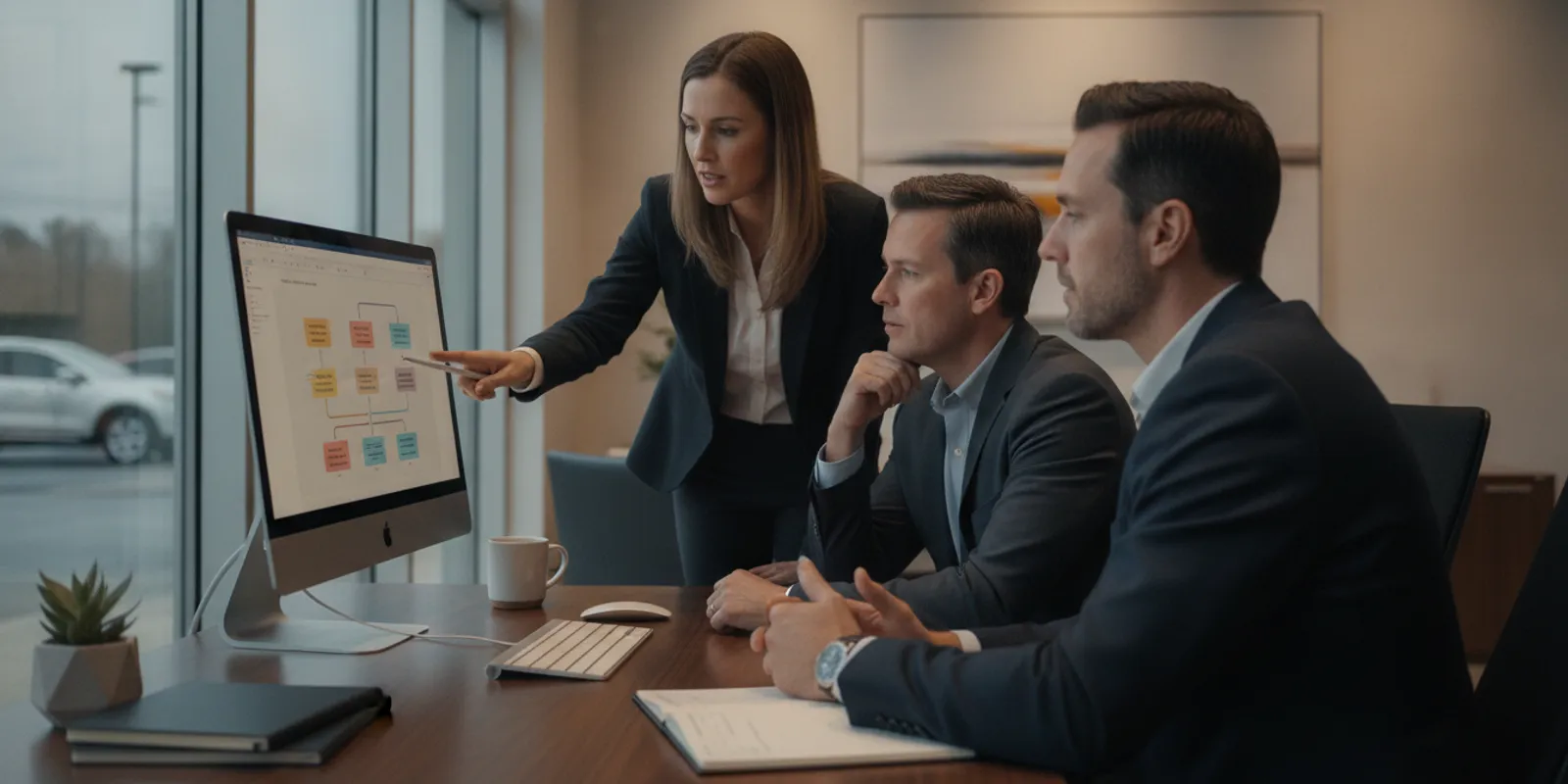
Automotive dealership technology is not one system or a shopping list of software. It is the connected tools and processes that help a store attract shoppers, respond to them, serve them, and learn what is working. The strongest stack is the one your team can use consistently, with clear ownership at every handoff.
Discuss your dealership's marketing goals
What does automotive dealership technology include?
Dealership technology spans customer-facing experiences and internal work. Shoppers may encounter a website, vehicle listings, digital retailing options, advertising, or messaging. Staff may rely on inventory feeds, customer records, operational platforms, campaign tools, and reports. A category matters only when it supports a defined task and fits the people who must use it.
Think in layers. The foundation stores and moves information. Customer-facing tools present vehicles and next steps. Sales and service systems coordinate work. Marketing tools create demand and communicate with shoppers. Measurement tools help leaders decide whether an activity contributes to an outcome. One platform may cover several layers, or a dealership may use separate systems. Neither setup is automatically best; fit with actual work matters.
This is a landscape overview, not a software shortlist or CRM setup manual. The useful question is not simply which products exist. It is which capabilities the store needs, how they connect to the customer journey, and whether people can carry out the process reliably. A technology decision should start with the work to improve, not the newest feature in a product demonstration.
Which technology categories should a dealership understand?
| Category | Primary job | Question to ask |
|---|---|---|
| Website and digital retailing | Present vehicles and next steps online | Can a shopper find the information and action needed? |
| CRM and lead workflow | Record inquiries and coordinate follow-up | Is each inquiry assigned a clear next step? |
| DMS and operational systems | Support transactions and records | Can staff find reliable information without duplicate work? |
| Inventory and merchandising | Organize vehicle details and presentation | Are listings accurate and updated? |
| Advertising and communication | Reach shoppers and encourage conversations | Does the message connect to a relevant action? |
| Analytics and reporting | Review activity and outcomes | Can leaders trace a measure to a decision? |
These categories overlap in the customer experience. A shopper may see an ad, visit a vehicle page, send a message, and then hear from a salesperson. The shopper experiences one journey even when several systems support it. Integration and process ownership therefore deserve as much attention as features in a vendor demonstration.
Consider a simple contrast. A vehicle listing platform may show the right inventory details, while the inquiry form sends incomplete information to a team queue. The listing function is doing its job, but the broader experience is not. Conversely, a clean handoff cannot compensate for a page that leaves the shopper unsure what to do. Review each tool in context, including the step before and after it.
How should a dealership map its current stack?
Start with work, not vendor names. Choose a recurring journey, such as an online vehicle inquiry, and list each step from first contact to appointment or resolution. For every step, identify the person responsible, the system used, and the information that must move forward.
- Choose one journey. Keep the first review narrow enough to complete. An online inquiry or a campaign response is usually easier to trace than every customer process at once.
- List the handoffs. Note where a shopper or record moves between people, channels, and systems. Include after-hours or reassignment steps if they are part of the real routine.
- Find repeated entry. Mark information staff enter more than once, plus manual exports, spreadsheets, and workarounds. Distinguish an occasional exception from the everyday process.
- Check ownership. Identify who maintains information and who acts when a task appears. A queue with no named owner is a process risk, regardless of which platform displays it.
- Validate the map. Ask the employees doing the work where delays or confusion occur. Compare documented steps with what happens during a busy shift.
- Record evidence. Capture examples of missing fields, duplicate records, unclear instructions, or delays. Describe the issue without assuming that technology is the cause.
For example, an inquiry may arrive through a vehicle page, enter a customer system, appear in a team queue, and then move to a salesperson. At each transition, check whether vehicle interest, the shopper's question, preferred contact method, and conversation history remain visible. If something is missing, note what it is and who first discovers the gap.
A map can distinguish a missing capability from a broken connection, unclear responsibility, or process nobody follows. Buying another platform may not fix a handoff that lacks an owner. If staff already have the necessary information but do not know which queue to check, clarify the routine and its accountability before shopping for more tools.
Keep the first map useful rather than exhaustive. A one-page flow with steps, owners, systems, and friction points is easier to validate than a large diagram nobody can maintain. Add a second journey only after the first one reveals a question that affects other work. This keeps the review focused and makes it easier to explain why a change is being considered.
How do systems connect across the shopper journey?
Follow information as well as the person. A lead record might include its source, vehicle interest, contact preference, and conversation history. The store should know where each item is captured, which system is authoritative, and who corrects errors. Without those decisions, two systems can display different versions and leave staff guessing which one to trust.
Use a handoff test: can the receiving employee understand what the shopper asked, what has happened, and what comes next without making the shopper repeat everything? If not, determine whether the gap is missing data, delayed transfer, unclear access, or an inconsistent routine. Ask the employee to demonstrate the steps using a realistic example rather than answering from memory.
Test integration claims against the dealership's actual setup. Ask vendors to demonstrate the fields, triggers, and outcomes the store needs. Confirm how errors appear, who resolves them, and what happens if a connection is unavailable. Test an ordinary case and an exception, such as an incomplete form, duplicate record, or shopper who changes channels. Record what happened instead of relying on a broad claim that products integrate.
Make a small handoff checklist for the test. Did the receiving person see the inquiry source? Was the vehicle or offer identified correctly? Did the shopper's message arrive intact? Could the assigned employee tell what action was expected? Was a failure visible to someone who could fix it? A single successful demonstration is not proof that every scenario is covered, but these questions reveal what still needs validation.
When reviewing a customer record, also distinguish information that is essential from information that is merely convenient. Collect and share only what the process needs, and agree who can view or change it. Ask vendors how data is stored, exported, corrected, and removed when appropriate. Bring legal, security, or compliance advisers into the discussion when the data or vendor terms warrant it; do not treat a feature checklist as a substitute for that review.
How should dealership leaders prioritize adoption?
Rank opportunities by the problem they solve, the people affected, and the evidence the store can gather. Consider these factors consistently:
- Customer friction: Does the change remove an obstacle or make the next action clearer?
- Staff burden: Does it reduce re-entry, searching, or uncertainty without adding hidden work?
- Process fit: Is there a named owner and a realistic routine?
- Data and access: Can the store define what information is needed and who may see or change it?
- Measurement: Can the dealership observe a useful before-and-after outcome?
- Change effort: Can the team train, test, and support the change without disrupting essential work?
- Dependency risk: Does the change rely on another vendor, a data feed, or an internal step that is not yet reliable?
A tool may offer a useful customer feature but require staff to re-enter information elsewhere. Another may connect well but add a confusing step for shoppers. Write down trade-offs and decide which constraint matters most. If the real issue is that nobody owns a follow-up queue, adding another channel can increase inquiries without fixing response ownership. A process adjustment may be the better first move.
A practical prioritization example: suppose the team reports that online inquiries arrive without clear vehicle details. One option is to replace the whole customer platform. Another is to inspect the form mapping and correct the fields. A third is to change the staff routine for checking the source page. Compare the effort, likelihood of resolving the observed issue, and impact on other work. The narrowest change that addresses a verified cause may be the sensible first test.
Do not score options only by the number of features they include. A broad package can appear attractive while leaving a particular handoff unresolved. Ask each team that will use the change to name the task it expects to become easier, the new steps it will add, and the person responsible for maintaining it. If the expected benefit cannot be explained in plain terms, clarify the problem before making a commitment.
How can a dealership evaluate a proposed technology change?
Write a short brief before selecting a solution. Include users, current process, desired change, required data, and how the store will judge whether the change helped. Then ask vendors to respond to the same scenario so the comparison is based on the dealership's needs rather than on polished but unrelated demonstrations.
- Describe the current state. Include steps, systems, users, and observed failure points. Use a real example with sensitive details removed.
- Set an outcome. Name a specific aim, such as fewer duplicate entries, clearer inquiry assignment, or a more consistent path from campaign response to conversation.
- Request a scenario-based demonstration. Ask to see routine tasks and exceptions. Have the vendor show what the employee does, not only what a manager sees in a dashboard.
- Clarify dependencies. Confirm integrations, data access, setup responsibilities, training, support, and what the dealership must provide.
- Test a limited workflow. Decide what to check, who provides feedback, how issues are recorded, and what would stop or change the test.
- Decide whether to expand, revise, or stop. Use evidence and staff feedback, not sunk effort or the excitement of a launch.
For a proposed reduction in manual transfers, observe several real handoffs. Record which fields arrived, which needed correction, and how staff handled failures. Ask how the solution behaves when data is incomplete, a user lacks permission, or a connection is delayed. Find out how employees get help and what fallback process they should use. A test should cover the less convenient cases as well as the smooth demonstration path.
Ask for the responsibilities in writing: who configures the connection, who checks it, who handles an error, and which party supports employees after launch. Clarify what the dealership can export if it changes systems later. The answer need not be complicated, but it should be specific enough that the store knows what it is agreeing to maintain. Include training time and internal coordination in the effort estimate, not only the vendor's setup tasks.
A useful test plan names its boundaries. For example, a store could test a single inquiry path with a defined group of users before changing every department's process. It should identify the start and end dates, normal and exception cases, feedback owner, and review meeting. If an issue occurs, decide in advance whether the team pauses, uses a manual fallback, or continues while a correction is made. That prevents a pilot from becoming an indefinite half-launch.
What should a dealership measure after adoption?
Choose measures that reflect the system's intended job. A customer-facing change may be assessed by completion of the intended action and quality of the experience. A workflow tool may be assessed by assignment, completion, or reduced repeat work. Consider marketing activity in the context of customer actions, not only platform activity.
Define measures before rollout. Record the current process, explain how each measure is counted, and set a review date. An automated acknowledgement and a useful employee reply are different events. A proposed appointment time and a confirmed visit are different too. If teams use different definitions, a report may look precise but obscure what happened.
Separate system usage from business outcomes. Logging in does not prove that shoppers receive better service. If underlying data is unreliable, state that limitation and improve measurement before drawing a firm conclusion. For marketing, connect campaign activity to a conversation, appointment, or sales opportunity. BDC Promotions describes its focus as helping dealerships turn online activity into appointments; its lead-to-showroom process provides context for the steps after a shopper responds.
Use a short measurement plan with three layers. First, confirm that the capability is being used as intended: are inquiries arriving, records appearing, or messages routing as expected? Second, check the process: are assigned people taking the agreed next steps, and are exceptions resolved? Third, review the customer or business outcome the change was meant to support. These layers help explain whether an outcome is weak because the tool failed, the workflow was not followed, or the original assumption was wrong.
Compare like with like. If a campaign, staffing pattern, or form changes at the same time as a new platform, a before-and-after comparison may not isolate the technology's contribution. Note those changes in the decision record. Use a review window suited to the work and allow time for staff to learn the process, but do not use an adjustment period as a reason to ignore repeated failures or unclear ownership.
How do advertising and communication tools fit?
Advertising technology can help a dealership present offers and vehicles, but it does not replace a clear audience, useful creative, or a response process. The ad should lead to a relevant destination, and the dealership should know who owns the inquiry. A click is only one part of the journey; shoppers need a credible next step after they respond.
Review the full path: message, destination, inquiry capture, response, and appointment follow-through. If the path breaks after the click, more campaign activity may simply produce more unanswered inquiries. See BDC Promotions' guidance on automotive ad creative and Facebook advertising for dealerships.
When assessing a campaign destination, check that it matches the promise in the creative. A shopper responding to a specific vehicle or promotion should not be sent to a page that offers no clear way to continue. Confirm that the next action works on a phone, that the relevant information reaches the right team, and that the team can see what prompted the inquiry. These are practical checks across marketing and operational tools, not a demand for one vendor to own the entire experience.
For lead conversations, decide how each channel is handled and what information moves forward. A Messenger lead workflow can help clarify assignment and next steps. The goal is a coherent customer experience, not adding channels without the capacity to manage them. Review automotive lead generation in the same context: how interest is created, captured, and moved toward a real conversation.
Give marketing and sales a shared description of the handoff. Marketing can identify the campaign, audience, creative, and destination; the receiving team can report whether inquiries included enough context and what happened next. Schedule a simple review of examples rather than relying on disconnected reports. If the message attracts a type of inquiry the store cannot currently handle, revise the audience, destination, or process before simply increasing activity.
What risks should leaders address before rollout?
Address access, data quality, training, and accountability during selection, not as late-stage cleanup.
- Data ownership: Decide which system is authoritative for each key record and how corrections happen.
- Access: Give users the permissions required for their work and review them when roles change.
- Workflow changes: Tell staff what changes, when, and where to get help.
- Measurement: Use consistent definitions and do not imply outcomes the data cannot support.
- Vendor dependence: Understand data export, account administration, support, and transition responsibilities.
- Customer communication: Ensure staff know what shoppers have already been told.
- Continuity: Document a fallback for outages or unavailable connections, and tell staff how to record work completed during the interruption.
Privacy and security duties depend on the systems and information involved. Involve appropriate legal, security, and compliance advisers when reviewing data practices, permissions, retention, and vendor terms. The Federal Trade Commission describes its consumer-protection role at the FTC website; consult qualified advisers about how requirements apply to a specific dealership.
Before launch, identify the system owner, list user roles, confirm access with a test account, document how data is corrected, and name the person who handles a failed connection. Review the process after staff have used it in real work. Make the support path easy to find; a technically available feature is not useful if employees cannot get an answer when it fails.
Plan for changes in people as well as platforms. If a key employee leaves or changes roles, someone else should know how to access essential queues, reports, and vendor support. Keep a basic inventory of systems, business owners, renewal dates, connected data, and recovery contacts. This is not a replacement for formal security or legal guidance. It is a practical way to reduce avoidable confusion during normal staff and vendor changes.
How can a dealership run a practical technology review?
A focused review can use four working sessions. First, map one journey and identify friction. Second, validate the map with employees who do the work. Third, compare possible changes against the same requirements. Fourth, agree on a limited test, an owner, and a review date.
Before the first session, choose a facilitator and ask participants to bring one concrete example of the process. Include the person who handles the inquiry, the person who receives the handoff, and a leader who can make a decision about priorities. For a marketing journey, include someone who understands how campaign responses are captured. Keep the group small enough to make decisions, then share the map with other affected staff for validation.
Keep a decision record with the problem, options, expected benefit, effort and costs to confirm with vendors, risks, and test evidence. This helps future leaders understand why a choice was made and whether assumptions still hold. A brief record can also prevent the same issue from being rediscovered every time a vendor or team member changes.
For related context, review the dealership software buyer guide for purchasing questions, and the automotive marketing services page for the service categories BDC Promotions describes. Keep these decisions separate from a general platform review: service fit and internal technology architecture are related, but they are not the same choice.
When a review identifies a campaign or shopper-conversation gap, BDC Promotions' dealership marketing overview describes its focus. Dealership teams can also consider the questions for evaluating a marketing agency when deciding what support is relevant to their goals. The right scope depends on the store's actual need and should be discussed clearly before work begins.
Frequently asked questions
What is automotive dealership technology?
It is the systems, channels, and processes a dealership uses to serve shoppers and support operations. It can include websites, customer records, inventory tools, advertising, communication, and reporting.
Does a dealership need every technology category?
No. The right mix depends on store goals, current systems, customer journeys, and ability to support adoption. Start with a specific problem and add capabilities only when they address a real need.
Should a dealership replace all systems at once?
A focused review and staged test make it easier to identify what helps and where problems occur. A broader change may sometimes be necessary, but map dependencies and responsibilities first.
How can leaders tell whether a new tool is working?
Set a baseline and choose measures tied to the tool's intended job. Review usage, workflow completion, customer experience, and relevant business outcomes separately, while noting data limitations.
How many systems should a dealership use?
There is no universal number. Each system should have a clear purpose, a responsible owner, and a manageable connection to the rest of the workflow.
Talk through your dealership's marketing priorities
A strong technology stack is built around customer journeys, clear ownership, and tools the team can use well. Start with one important process, identify its friction, and make the next decision against that evidence.